Key concepts
Hazards
A hazard is something that could cause:
- harm to someone
- damage to something
- adverse health effects, either straightaway or later
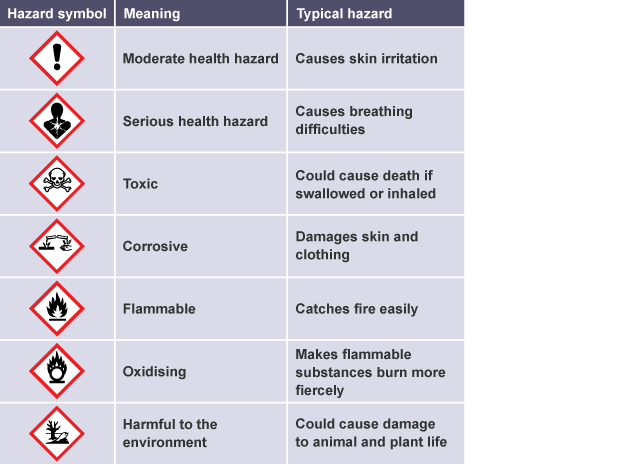
Hazard symbols are designed to provide a warning, even if a person cannot understand the writing that goes with them.
Risk
Hazards and risks are connected. A risk is the chance that a hazard will cause harm.
When evaluating a risk, think about factors such as:
- the way the hazard causes harm
- how likely it is that someone or something will be exposed to the hazard
- how serious the effects of the hazard could be
When evaluating a risk, think about factors such as:
the way the hazard causes harm
how likely it is that someone or something will be exposed to the hazard
how serious the effects of the hazard could be
Glossary
Anion: A negatively charged ion. Formed when an atom gains at least one electron.
Atom: The smallest part of an element that can exist. All substances are made up of atoms.
Atomic nucleus: Positively charged object composed of protons and neutrons at the centre
of every atom with one or more electrons orbiting it.
Atomic number: The number of protons in the nucleus.
Avogadro’s constant: The number of atoms, molecules or ions in a mole of a given
substance.
Cation: A positively charged ion. Formed when an atom loses at least one electron.
Compound: A substance made up of two or more types of atoms chemically combined
together.
Concentration: The amount of substance (e.g. the mass) in a certain volume of a solution.
Conductor: A material that contains charged particles which are free to move to carry
electrical or thermal energy.
Conservation of mass: A law which states that no atoms are lost or made during a chemical
reaction so the mass of the products equals the mass of the reactants.
Covalent bond: A shared pair of electrons between two non-metals.
Dalton model: Dalton described atoms as solid spheres, stating that different spheres made
up the different elements.
Diamond: A giant covalent structure which is made up of carbon atoms each of which form
four covalent bonds with four other carbon atoms.
Electron: Negatively charged subatomic particle which orbit the nucleus at various energy
levels. Very small relative mass (negligible).
Electron shell: Different energy levels in atoms occupied by electrons.
Electrostatic forces: The strong forces of attraction between oppositely charged ions.
Element: A substance made up of only one type of atom.
Empirical formula: The simplest whole number ratio of atoms of each element in a
compound.
Fullerenes: Molecules of carbon atoms with hollow shapes. The structures are based on
hexagonal rings of carbon atoms but they may also contain rings with five or seven carbon
atoms. Examples include graphene and C60.
Giant covalent molecule: Molecules containing many atoms covalently bonded together.
Graphene: A single layer of graphite with properties that make it useful in electronics and
composites.
Graphite: A giant covalent structure which is made up of carbon atoms each of which form three covalent bonds with three other carbon atoms. The atoms form layers of hexagonal rings which have no covalent bonds between them. There is one delocalised electron per carbon atom which is free to move to carry charge.
Group (periodic table): A column of the periodic table. Elements in the same group have
similar chemical properties.
Intermolecular forces: The forces which exist between molecules. The strength of the
intermolecular forces impact physical properties like boiling/melting point.
Ion: An atom or molecule with an electric charge due to the loss or gain of electrons.
Ionic bond: The bond formed between the oppositely charged ions when a metal atom loses electron(s) to form a positively charged ion and a non-metal gains these electron(s) to form a negatively charged ion.
Ionic compound: Chemical compound formed of oppositely charged ions, held together by strong electrostatic forces.
Isotope: Atoms of the same element with the same number of protons but a different number of neutrons.
Lattice: A repeating regular arrangement of atoms/ions/molecules. This arrangement occurs in crystal structures.
Limiting reactant: The reactant that is completely used up since it limits the amount of
products formed.
Mass number: The total number of protons and neutrons in the nucleus.
Metallic bond: The bonds present in metals between the positive metal ions and negatively charged electrons.
Metals: Elements that react to form positive ions. Found to the left and towards the bottom of the periodic table.
Mole: The unit for amount of substance. The symbol for the unit mole is mol.
Molecular formula: The actual ratio of atoms of each element present in a compound.
Molecule: A group of at least two atoms held together by covalent bonds.
Neutron: Neutral subatomic particle present in the nucleus of the atom. Relative mass of 1.
Non-metals: Elements that react to form negative ions. Found towards the right and top of the periodic table.
Period (periodic table): A row of the periodic table. Elements in the same period have the same number of electron shells.
Periodic table: Table of elements arranged in order of increasing atomic number and such that elements with similar properties are in the same column (group).
Polymers: Large long-chain molecules made up of lots of small monomers joined together
by covalent bonds.
Proton: Positively charged subatomic particle present in the nucleus of the atom. Relative mass of 1.
Relative atomic mass: An average value that takes into account the abundances of the isotopes of the element.
Relative formula mass: The sum of the relative atomic masses of the atoms in the numbers shown in the formula. It is numerically equal to the mass of one mole of a substance in grams.
Simple molecules: Molecules containing a fixed number of atoms covalently bonded together.
Subatomic particles: Particles smaller than an atom. Protons, neutrons and electrons are the three most common subatomic particles.
Anion: A negatively charged ion. Formed when an atom gains at least one electron.
Chlorination: A process used in water treatment where chlorine gas is injected into the water to kill any microbes.
Chromatography: A process used to separate substances in a mixture. Separation of the substance depends on distribution between a mobile phase and a stationary phase.
Crystallisation: A separation technique to obtain soluble solids from solutions. The process involves heating the solution until crystals start to form, leaving the solution to cool and then filtering the formed crystals from the solution.
Filtration: A separation technique used to separate an insoluble solid from a solution.
Fractional distillation: A process used to separate a mixture of liquids. The liquids have different boiling points so can be separated into different fractions within a fractionating column.
Gas: The state of matter where the particles have the most energy. The particles in a gas are relatively spread out and move randomly in all directions.
Groundwater: Water that collects in rocks that then trap the water underground.
Liquid: The state of matter where the particles are arranged randomly and close together. The particles are able to move past each other.
Melting point data: Data that can be used to evaluate the purity of a substance. A pure substance should have a sharp melting point.
Mixture: Contains at least two different elements or compounds that are not chemically bonded together.
Mobile phase: The fluid (gas or liquid) which moves through the chromatography system, carrying the mixture which is to be separated.
Paper chromatography: A type of chromatography which uses paper as the stationary phase and a solvent as the mobile phase. The solvent carries the mixture up the paper where the substances in the mixture then separate, depending on how soluble they are in the mobile phase.
Particle theory: The theory which models the three states of matter by representing the particles as small solid spheres. Particle theory can help to explain melting, boiling, freezing and condensing.
Potable water: Water that is safe for humans to drink.
Pure substance: The chemistry definition of a pure substance is a substance that contains only one compound or element. The everyday definition of a pure substance is a substance that has nothing added to it, e.g. pure milk.
Rf value: A value used in chromatography which is calculated as the distance travelled by the dissolved substance divided by the distance travelled by the solvent. It can be used to identify substances within a mixture.
Sedimentation: A process used in water treatment to remove solids from the water. Suspended solids will fall to the bottom of the container and form a sediment, allowing them to be easily removed.
Simple distillation: A separation technique used to separate a liquid from a solution. The solution is heated so that only the liquid with the lowest boiling point evaporates. This gas is then condensed in a condenser before being collected as a liquid.
Solid: The state of matter where the particles hold a regular arrangement and have the least amount of energy.
State symbols: The symbols used in chemical equations to denote the states of the chemicals reacting: (s) - solid, (l) - liquid, (g) - gas, (aq) - aqueous solution.
Stationary phase: The nonmoving phase which the mobile phase passes over during chromatography.
Wastewater: Water from industrial, domestic, agricultural and commercial activity. It requires treatment before it is potable.